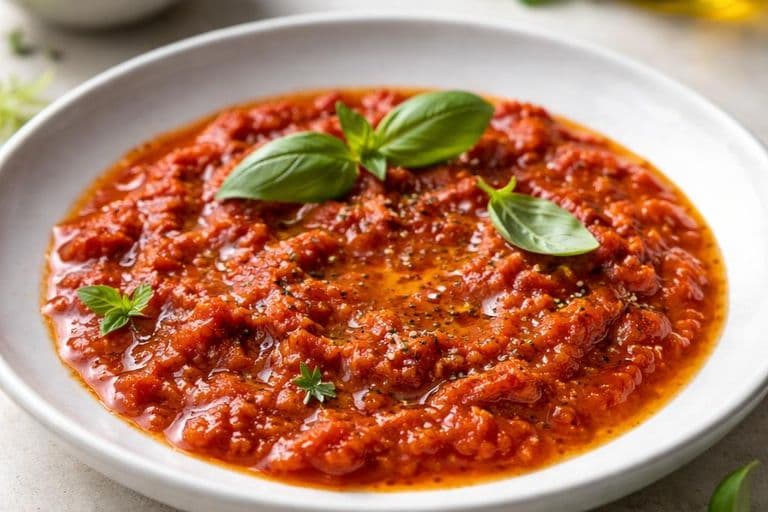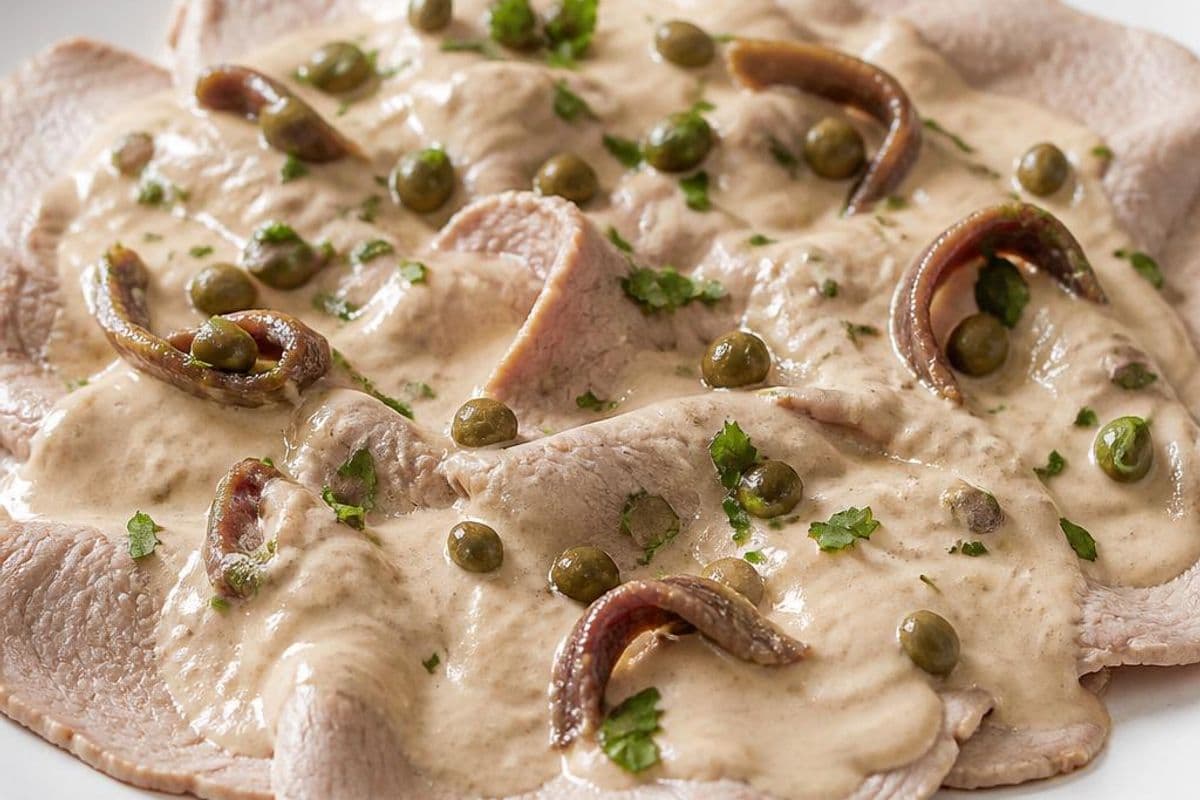
Vitello Tonnato (Cold Veal with Tuna Sauce)
Tender poached veal served paper-thin with a silky tuna‑anchovy‑caper sauce. Classic Piedmontese antipasto — elegant, make‑ahead and utterly moreish.
Vitello tonnato is the kind of dish Italians trot out when they want to look effortlessly elegant — cold, refined and utterly convivial. It’s from Piedmont and traditionally appears at summer lunches, Christmas buffets and whenever hosts want something make‑ahead and showy.
This version keeps the technique honest: a gently poached veal joint sliced paper‑thin and coated in a silky tuna‑anchovy‑caper sauce. It’s make‑ahead magic — the flavours actually improve after a night in the fridge, so it’s perfect for entertaining.
If you’ve never made it, don’t be intimidated. The critical parts are gentle poaching and chilling the meat before slicing; everything else is forgiving and deliciously rewarding.
Ingredients
- 1.2 kg veal topside or eye of round (boneless)
- 15 ml sea salt (for poaching liquid) — about 15 g
- 10 pieces black peppercorns
- 2 leaves bay leaves
- 1 medium onion — halved
- 1 medium carrot — roughly chopped
- 2 stalks celery stalks — roughly chopped
- 3 sprigs fresh parsley
- 250 ml dry white wine
- 1.2 l water
- 30 ml olive oil (for searing)
- 180 g tinned tuna in oil, drained — good quality, drained weight
- 200 g good-quality mayonnaise — or use homemade mayonnaise
- 3 fillets anchovy fillets (in oil) — about 15 g
- 30 ml capers — plus extra for garnish
- 30 ml fresh lemon juice — juice of about 1 small lemon
- 45 ml extra virgin olive oil (for sauce) — 3 tbsp
- 15 ml caper brine (optional, for brightness) — adds salt/acid if sauce needs lift
- 15 ml fresh parsley leaves (to serve) — chopped
- 6 slices lemon slices (to serve)
- salt & freshly ground black pepper — to taste (for seasoning sauce and meat if needed)
- kitchen string (for tying roast, optional) — keeps the roast compact for even slicing
Equipment
- large heavy-bottomed saucepan or casserole
- skillet for searing
- food processor or blender
- fine-mesh sieve
- instant-read thermometer
- kitchen string (for tying roast, optional)
Instructions
Trim any large areas of fat or sinew from the veal and tie the roast at 3–4 cm intervals with kitchen string so it keeps a neat cylinder—this makes it far easier to slice thinly later.
Season the veal all over with a little salt and pepper. Heat 2 tbsp olive oil in a large heavy‑bottomed skillet over medium‑high heat and sear the veal on all sides until golden (about 2–3 minutes per side). You’re building flavour—don’t skip the sear.
In a large saucepan or casserole, combine the halved onion, chopped carrot, chopped celery, white wine and water. Add bay leaves, peppercorns, parsley sprigs and 1 tbsp sea salt. Bring to a gentle simmer and cook for 10 minutes to marry the flavours.
Lower the seared veal into the simmering liquid so it’s mostly covered. Keep the liquid at the gentlest of simmers (tiny bubbles) and cook, partially covered, for 75 minutes. Check with an instant‑read thermometer from 55–60 minutes onward: you want an internal temperature of 60–62°C for slightly pink (or 65°C if you prefer fully done).
When the roast reaches the target temperature, remove the pot from the heat and leave the veal submerged in the cooking liquor to cool to room temperature (this keeps it moist). Leave for 1.5–2 hours.
While the veal cools, make the tonnato sauce. In a food processor or blender combine drained tuna, mayonnaise, anchovy fillets, 2 tbsp capers, lemon juice, 3 tbsp extra‑virgin olive oil and 1 tbsp caper brine (if using). Blitz to a very smooth paste (about 1–2 minutes). Taste and adjust with salt, pepper or more lemon if needed. If the sauce is too thick, loosen with a tsp or two of the reserved poaching liquid or a little water.
Remove the veal from the liquid, pat dry and wrap tightly in clingfilm. Refrigerate until well chilled and firm, at least 1–2 hours (this makes razor‑thin slicing possible).
Using a very sharp knife (or slicer), cut the veal into the thinnest possible slices. Arrange overlapping on a large platter. Spoon the tonnato sauce over the slices in an even layer (or serve sauce to the side). Scatter extra capers, parsley and lemon slices over the top.
Cover the platter with clingfilm and chill for at least 6 hours so the flavours marry (overnight is best). Serve chilled as an antipasto with lemon wedges, extra capers and crusty bread or a peppery salad.
Tips
- Use an instant‑read thermometer when poaching—the target is 60–62°C for slightly pink meat (65°C if you prefer fully done). This avoids overcooking.
- Chill the roast thoroughly before slicing. Warm meat tears; chilled meat slices paper‑thin and keeps a neat presentation.
- For the silkiest sauce, blitz the tuna mixture in a food processor then push it through a fine sieve. If it’s too thick, loosen with a teaspoon of the poaching liquid.
- Make it a day ahead: the veal tastes much better after the sauce has rested on it for several hours or overnight.
- If you don’t want to use raw‑colour mayonnaise, substitute with a light, neutral oil emulsion made from blended cooked egg yolks and oil (use pasteurised eggs if worried about safety).
Substitutions
Veal topside → Beef silverside or rump (stay-close: similar texture but more pronounced beef flavour)
Stays closeMayonnaise → Greek yoghurt mixed with a little extra olive oil (noticeably-different: tangier, lighter texture)
Noticeably differentTinned tuna in oil → Tuna in water (stay-close: lower fat and slightly drier — add a little extra olive oil)
Stays closeAnchovy fillets → 1 tsp Worcestershire sauce (noticeably-different: less pure anchovy umami)
Noticeably different
Nutrition
Per serving · estimated
- 630
- Calories
- 55 g
- Protein
- 3 g
- Carbs
- 35 g
- Fat
- 1 g
- Fibre
- 2 g
- Sugar
- 900 mg
- Sodium
FAQ
Can I make vitello tonnato ahead?
Yes — make the veal and sauce a day in advance. Assemble the slices with the sauce and chill for at least 6 hours or overnight; the flavour improves with time.
Is the veal safe to eat cold?
Yes — the veal is fully cooked by poaching to the recommended internal temperature and then chilled. Follow safe cooling and refrigeration practices (cool in the cooking liquid, then refrigerate).
How thin should I slice the veal?
As thin as you can manage — paper‑thin is ideal. A sharp slicer or very sharp knife and a well‑chilled roast are the keys.
Can I use leftover roast beef instead of cooking veal?
Yes — leftover roast beef works fine. Slice thinly and proceed with the sauce; flavour will differ slightly but the dish is still excellent.
Community Photos
No photos yet
Be the first to share your creation!