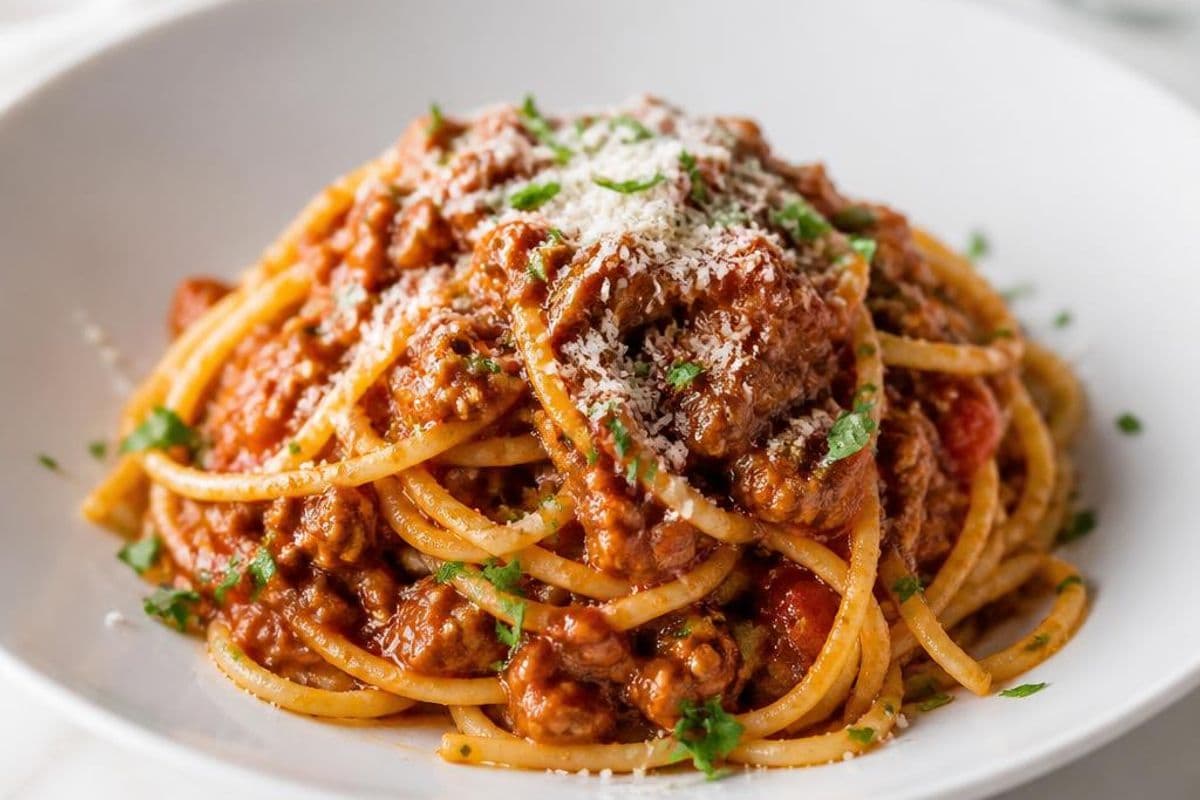
Spaghetti Bolognese (Slow-Simmered Ragu)
Classic Italian spaghetti dressed in a rich, slow-simmered meat ragu — savoury, slightly sweet from milk and tomato, and perfect for a cosy midweek dinner or a relaxed Sunday.
This is the kind of Bolognese that makes you forgive yourself for not being Italian. It’s a proper ragù: slow-simmered, layered with sweetness from milk and carrot, depth from wine and pancetta, and rounded off with a silky texture that clings to every strand of spaghetti.
Make it for a cosy midweek supper or for friends — it rewards patience. Little hands-off simmering and a good browning step are what make this sing; the rest is comfort in a bowl.
Ingredients
- 30 ml extra virgin olive oil
- 20 g unsalted butter
- 1 medium onion — finely diced (about 150 g)
- 1 medium carrot — finely diced
- 2 sticks celery — finely diced
- 3 cloves garlic — crushed or finely chopped
- 75 g pancetta or streaky bacon — finely diced (optional but recommended)
- 500 g minced beef — lean mince (or mix of beef & pork — see substitutions)
- 30 ml tomato purée (concentrated)
- 150 ml red wine — dry red wine
- 400 g passata — or smooth tomato sauce
- 400 g chopped tomatoes (tin) — one 400 g tin
- 250 ml beef stock — or water + 1 beef stock cube
- 150 ml whole milk
- 1 bay leaf
- 5 ml dried oregano
- salt — to taste
- freshly ground black pepper — to taste
- 320 g spaghetti (dry) — about 80 g per person
- 15 ml fresh flat-leaf parsley — finely chopped, for serving
- 40 g Parmesan — freshly grated, to serve
Equipment
- large heavy-based saucepan or casserole with lid
- large pot for boiling pasta
- wooden spoon or sturdy spatula
- colander
- fine grater (for Parmesan)
Instructions
Prepare the veg: finely dice the onion, carrot and celery (the classic soffritto). Crush or finely chop the garlic. Set everything to one side.
Heat a large heavy-based saucepan or casserole over medium heat. Add the olive oil and butter and let the butter melt (about 30 seconds).
Add the diced onion, carrot and celery with a pinch of salt. Sweat gently over medium-low heat until soft and slightly caramelised, about 8–10 minutes. Stir every 1–2 minutes so nothing sticks.
Add the pancetta (if using) and cook for 3–4 minutes until it starts to render fat. Then add the garlic and cook 30–45 seconds until fragrant.
Increase the heat to medium-high and add the minced beef. Break it up with a wooden spoon and spread it out so it has contact with the pan. Leave it undisturbed for 1–2 minutes to brown, then stir and continue until all meat is browned and no pink remains, about 6–8 minutes total.
Stir in the tomato purée and fry for 1–2 minutes to caramelise slightly — this deepens the tomato flavour.
Pour in the red wine to deglaze the pan. Use the spoon to scrape up any browned bits from the bottom. Let the wine reduce by about half, roughly 2–3 minutes.
Add the passata, chopped tomatoes, beef stock, bay leaf and dried oregano. Stir to combine. Bring to a gentle simmer.
Reduce the heat to very low and stir in the milk. This softens the tomato acidity and gives the ragu a silky finish.
Partially cover the pan with a lid (slightly ajar) and let the sauce simmer very gently for 1¼–1½ hours, stirring every 10–15 minutes. If the sauce reduces too quickly, add a splash of stock or hot water.
15 minutes before the end of cooking, taste and season with salt and pepper. Remove the bay leaf. If the sauce feels thin, simmer uncovered to thicken; if too thick, loosen with a little stock.
When the sauce is nearly ready, bring a large pan of salted water to a rolling boil. Add the spaghetti and cook to package instructions minus 1 minute for al dente (usually 8–10 minutes depending on brand).
Drain the spaghetti, reserving 150 ml (about a mug) of the pasta water. Return pasta to the pan or add directly to the ragu. Toss together over low heat for 1–2 minutes, adding splash(es) of pasta water until the sauce nicely coats the spaghetti.
Serve immediately scattered with chopped parsley and a good grating of Parmesan. Drizzle a little extra virgin olive oil if you like.
Leftovers: cool quickly and store in the fridge for up to 3 days or freeze in portions for up to 3 months. Reheat gently and add a splash of water or stock if thickened.
Tips
- Sweat the soffritto (onion, carrot, celery) slowly — it builds the backbone of flavour. If you rush it you’ll notice a flatness in the finished sauce.
- Brown the meat in batches if the pan is crowded — you want caramelisation, not steaming.
- Reserve a mug of pasta water before draining; the starchy liquid helps emulsify the sauce and pasta so it clings perfectly.
- Make-ahead: the ragu improves a day after cooking — cool and refrigerate, then gently reheat and loosen with stock or water.
- If you run out of time, simmer for 30–40 minutes—still tasty—but the best texture and flavour develop after at least an hour.
Substitutions
minced beef → mix 300 g minced beef + 200 g minced pork for a richer, more traditional ragù
Stays closepancetta → omit or use 50 g smoked bacon
Stays closered wine → extra beef stock + 1 tsp balsamic vinegar or Worcestershire for acidity if avoiding alcohol
Noticeably differentspaghetti (gluten) → use tagliatelle or pappardelle (stays-close), or gluten-free spaghetti (stays-close)
Stays close
Nutrition
Per serving · estimated
- 720
- Calories
- 36 g
- Protein
- 82 g
- Carbs
- 26 g
- Fat
- 7 g
- Fibre
- 8 g
- Sugar
- 650 mg
- Sodium
FAQ
Can I make this without wine?
Yes — substitute with extra stock plus a teaspoon of balsamic or Worcestershire for depth. You’ll lose some of the wine’s acidity and flavour complexity but it will still be delicious.
Why do you add milk?
Milk tones down the acidity of the tomatoes, softens the meat and gives the sauce a richer, silkier mouthfeel — it’s traditional in many authentic recipes.
How long should I simmer the sauce?
Ideally 1¼–1½ hours on a very gentle simmer. You can do 30–40 minutes in a hurry, but longer slow cooking gives better texture and flavour.
Can I freeze the ragu?
Yes — cool completely, portion into airtight containers and freeze for up to 3 months. Thaw overnight in the fridge and reheat gently, adding a splash of stock if needed.
Community Photos
No photos yet
Be the first to share your creation!