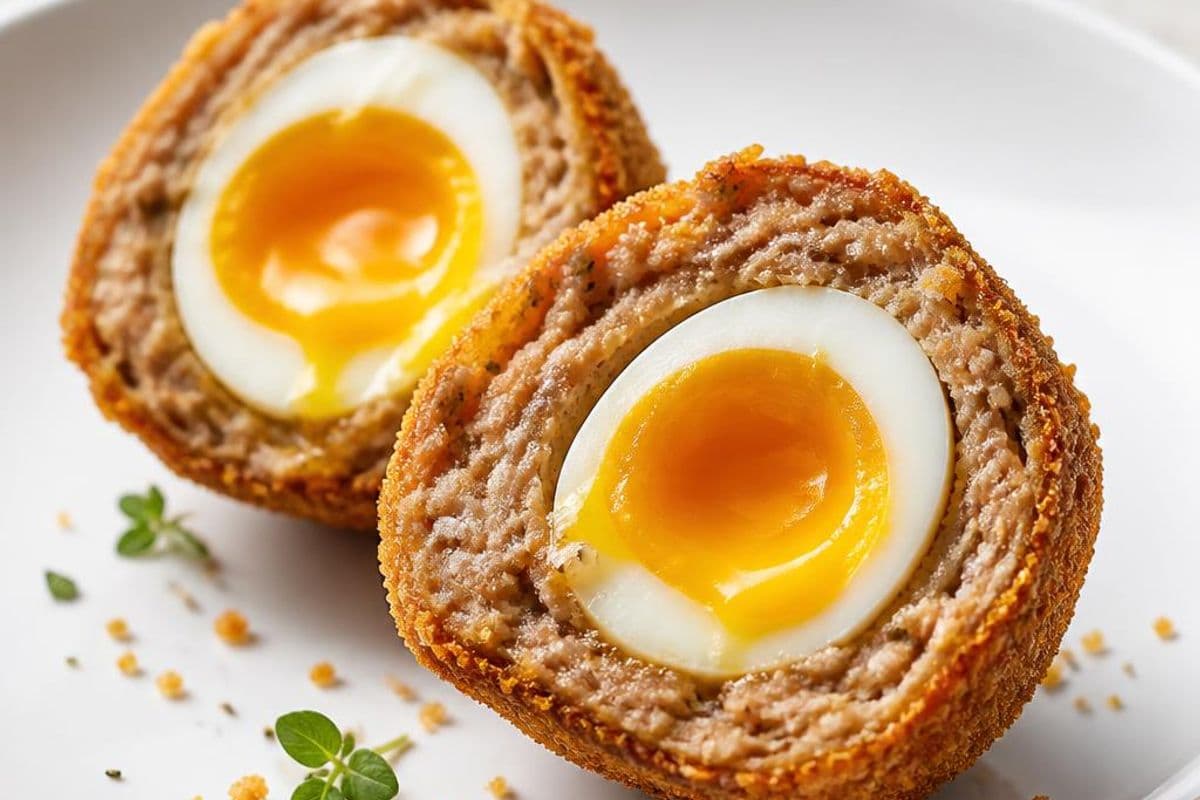
Classic Scotch Eggs (Jammy-centre)
Crispy breadcrumb shell, seasoned pork sausage wrapped around a soft‑set (jammy) boiled egg — perfect hot or cold for picnics, ploughman’s lunches or a proper snack.
A proper Scotch egg is portable comfort: crisp on the outside, meaty and seasoned, with that glorious jammy yolk in the middle. Make them for a picnic, a cheeky pub-style supper or to impress guests at a buffet.
This version keeps things classic — seasoned pork sausage, panko for extra crunch and careful timing so you get the yolk just shy of fully set. A little patience (and a short chill) is what separates the soggy impostors from the glorious originals.
Ingredients
- 6 large eggs — 4 for the centres, 2 beaten for the breadcrumb wash
- 450 g good-quality pork sausage meat
- 100 g panko breadcrumbs
- 75 g plain (all-purpose) flour
- 5 ml Dijon mustard
- 5 ml Worcestershire sauce
- 15 g fresh parsley, finely chopped
- 5 ml fine sea salt — for sausage mix
- 5 ml freshly ground black pepper
- 600 ml vegetable oil (for deep-frying) — enough for 5–7 cm oil depth in a saucepan
- 30 ml wholegrain mustard or piccalilli (to serve)
- 1 optional: small shallot, very finely chopped — about 30 g — adds moisture and flavour to sausage meat
Equipment
- deep heavy saucepan or deep-fryer
- digital thermometer
- slotted spoon
- wire cooling rack
- kitchen scales (for even portions)
Instructions
Bring a medium saucepan of water to a gentle rolling boil. Carefully lower 4 whole eggs (for the centres) into the water using a slotted spoon.
While eggs cook, prepare an ice bath (bowl of cold water + ice). When the 6 minutes are up, transfer eggs straight into the ice bath to stop cooking and cool completely.
Peel the cooled eggs gently. If a small membrane peels away, rinse under cold water to clean the surface and pat dry on a paper towel.
In a bowl, mix the sausage meat with Dijon mustard, Worcestershire sauce, chopped parsley, shallot (if using), 1 tsp salt and 1/2 tsp black pepper. Mix briefly — handle as little as possible so the meat doesn’t become gummy.
Divide the sausage mixture into 4 even portions (≈112–113 g each). Flatten each portion in the palm of your hand or on cling film into a disc roughly 1 cm thick.
Wrap each peeled egg with a sausage disc: place egg in centre, fold meat up and around, sealing seams by pinching. Smooth the surface so there are no gaps. Place sealed eggs seam-side down on a tray.
Set up a breading station: bowl of flour, bowl with 2 beaten eggs, and plate with panko breadcrumbs. Dredge each sausage-wrapped egg in flour (shake off excess), dip in beaten egg, then roll in panko to fully coat.
Chill the coated Scotch eggs on a tray in the fridge for 20 minutes to firm the coating — this reduces the risk of the breadcrumb layer sloughing in the oil.
Pour oil into a deep, heavy saucepan to a depth of about 5–7 cm. Clip in a digital thermometer and heat to 170°C (340°F). If you don't have a thermometer, heat until a cube of bread browns in ~30 seconds.
Fry the Scotch eggs in batches (do not overcrowd) for 3–4 minutes per batch, turning gently so they brown evenly to a deep golden colour. Use a slotted spoon to turn and remove.
Drain cooked Scotch eggs on a wire rack for 5 minutes. Resting lets residual heat finish cooking the sausage without overcooking the yolk.
Slice in half to check the yolk (should be jammy). Serve warm or at room temperature with wholegrain mustard or piccalilli.
Baking alternative: if you prefer less oil, bake at 200°C (fan 180°C) for 25–30 minutes on a wire rack over a tray — brush or spray lightly with oil before baking for better colour.
Tips
- For reliably jammy centres, use large eggs and time the boil to 6 minutes exactly — use a timer and an ice bath afterwards.
- Chill the coated eggs before frying — it firms the sausage and breadcrumb coating so they keep their shape and don’t fall apart in the oil.
- Use a digital thermometer for the oil (170°C/340°F is ideal). If it’s too hot the crust will brown before the sausage cooks; too cool and the coating becomes greasy.
- Make-ahead: assemble and chill un-fried Scotch eggs up to 24 hours in advance. Fry just before serving or bake from chilled for 30–35 minutes.
- To reheat: 170°C oven for 10–12 minutes (from chilled) keeps the crust crisp without overcooking the yolk.
Substitutions
pork sausage meat → a mix of 400 g minced pork + 50 g finely chopped streaky bacon (season with the same herbs and mustard)
Stays closepanko breadcrumbs → regular fresh breadcrumbs (make from day-old bread) or 100 g gluten-free breadcrumbs
Stays closedeep-frying in oil → bake at 200°C (fan 180°C) for 25–30 minutes, turning once and brushing with oil
Noticeably differentDijon mustard → English mustard or wholegrain mustard (use a touch less English as it’s hotter)
Stays close
Nutrition
Per serving · estimated
- 720
- Calories
- 28 g
- Protein
- 22 g
- Carbs
- 52 g
- Fat
- 1 g
- Fibre
- 2 g
- Sugar
- 800 mg
- Sodium
FAQ
How do I get a jammy yolk instead of a hard one?
Time the boil precisely — 6 minutes for a jammy large egg. Immediately transfer to an ice bath for 5 minutes to stop cooking. Keep eggs cold while peeling and wrapping.
Can I make Scotch eggs ahead of time?
Yes. You can assemble and chill (unfried) up to 24 hours ahead. Fry or bake just before serving. Cooked Scotch eggs keep in the fridge for 3 days.
Can I freeze Scotch eggs?
Yes — freeze uncooked, breaded Scotch eggs on a tray until firm, then bag them. Fry or bake from frozen (add a few minutes to cooking time). Texture may be slightly affected.
Why did my breadcrumb coating fall off?
Most likely the coating wasn’t rested/chilled enough or the meat was handled too much (creating moisture). Make sure to chill for at least 20 minutes and press breadcrumbs firmly to adhere.
Can I make vegetarian Scotch eggs?
Yes — use seasoned mashed chickpeas or spiced vegetarian mince around the egg, or a vegan 'egg' alternative. Result will be noticeably different in flavour and texture.
Community Photos
No photos yet
Be the first to share your creation!