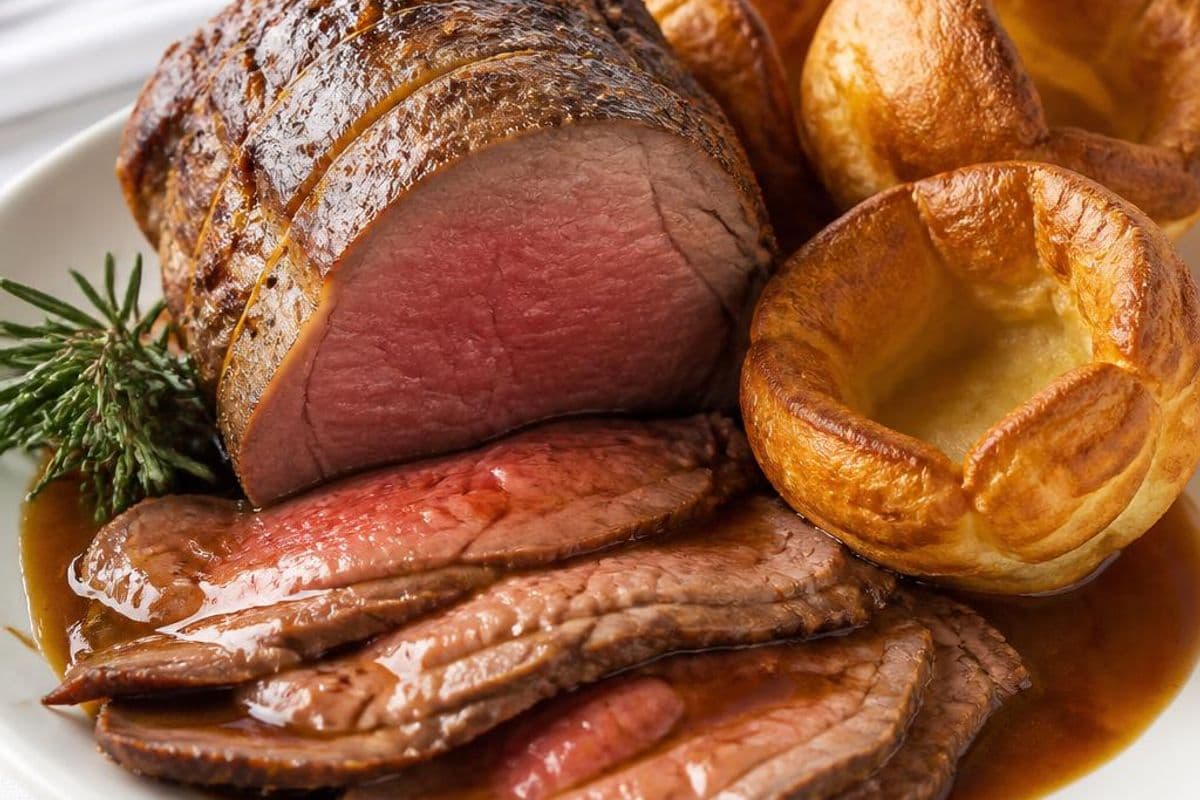
Classic Roast Beef with Yorkshire Puddings
A proper British Sunday roast: a tender, medium-rare roast beef joint with glossy pan gravy and golden, puffed Yorkshire puddings. Comforting, showy and excellent for Sunday guests (or impressive midweek leftovers).
This is how Sundays in the UK earned their reputation: big joint of roast beef, puffed Yorkshire puddings and gravy that soaks into everything. It’s showy but not fussy — the tricks are mostly timing and temperature.
Make this when you want a proper roast that feeds a small crowd, or when you want leftovers that turn into legendary sandwiches. The beef sings when rested properly and the Yorkshire puddings will puff if you don't faff about with cold fat or an open oven.
Ingredients
- 1 1/2 kg beef roasting joint (topside, sirloin or rump)
- 30 ml vegetable oil (for searing)
- 25 g unsalted butter — softened, to baste
- 15 ml coarse sea salt
- freshly ground black pepper — to taste
- 4 cloves garlic cloves — crushed (optional)
- 140 g plain (all-purpose) flour — for Yorkshire puddings
- 4 large eggs
- 200 ml milk (whole or semi-skimmed)
- 5 ml fine salt (for batter)
- 45 ml beef dripping or vegetable oil (for tin) — heated in tin until smoking
- 250 ml beef stock — for gravy (optional)
- 5 ml cornflour — mixed with 1 tbsp cold water to thicken gravy (optional)
- fresh parsley — chopped, to garnish (optional)
Equipment
- roasting tray
- wire rack
- meat thermometer (probe)
- 12-hole muffin tin or popover tin
- mixing bowl and whisk
Instructions
Remove the beef from the fridge at least 30 minutes before cooking so it comes closer to room temperature. Pat dry with kitchen paper.
Preheat the oven to 240°C (220°C fan). Rub the joint all over with the oil, then season generously with the coarse sea salt and plenty of black pepper. Rub the crushed garlic over the surface if using.
Sear the beef in a hot roasting tray or frying pan over high heat until all sides are browned (about 3–4 minutes per side). Transfer to a roasting tray on a rack and put in the hot oven.
Roast at 240°C for 20 minutes to blast the outside, then reduce the oven to 190°C (170°C fan) and continue roasting for approximately 20 minutes per 500 g for medium-rare. For 1.5 kg aim for 60 minutes at the lower temperature (so 20 minutes initial + 60 minutes).
While the beef roasts, make the Yorkshire batter. In a bowl whisk the flour and salt, whisk in the eggs until smooth, then gradually whisk in the milk until you have a loose batter. Strain if lumpy. Leave to rest for at least 30 minutes at room temperature (or fridge up to 24 hours).
When the beef is about 10–15 minutes from coming out, place a 12-hole muffin or popover tin in the oven and add about 1/2 tsp (or 1/4 tsp for larger holes) of beef dripping or oil into each hole. Heat until the fat is smoking hot—this takes around 5–7 minutes. (Heat tin at same 190°C oven; the tin must be very hot.)
Remove the beef from the oven when it hits your target temperature and transfer to a warm board. Cover loosely with foil and rest for 20–30 minutes. During this time the meat will carryover cook a few degrees.
Immediately after the tin and fat are smoking, remove the tin from the oven and pour the rested Yorkshire batter quickly into each hot cavity (fill about two-thirds). Work fast — the fat must still be hot when batter goes in. Return the tin to the oven.
Bake the Yorkshire puddings at 200–220°C (fan ovens 180–200°C) for 20–25 minutes until well risen and deep golden brown. Avoid opening the oven door while they’re rising.
While Yorkshire puddings bake, make a quick gravy from the beef tin juices: pour the roasting tray juices into a saucepan, skim off excess fat (reserve a little for flavour), add the beef stock and simmer for 4–5 minutes. If needed, thicken with the cornflour slurry and season to taste.
Carve the rested beef thinly against the grain, spoon over any resting juices, serve with the puffed Yorkshire puddings and drizzle with gravy. Scatter chopped parsley to finish, if using.
Tips
- Bring the joint out of the fridge 30 minutes before roasting so it cooks evenly — cold meat = uneven doneness.
- Heat the fat until smoking for Yorkshire puddings. If the fat isn’t hot they’ll flop; test one hole first if you’re unsure.
- Use a thermometer for the beef: 55–58°C for medium-rare, 60–65°C for medium. Temperatures rise a few degrees while resting.
- Make the batter the night before and keep it covered in the fridge — rested batter often gives a better rise (bring back to room temp before using).
- If your gravy tastes flat, add a teaspoon of Worcestershire sauce, a splash of red wine or a squeeze of lemon to brighten it.
Substitutions
beef joint (topside/sirloin/rump) → rib-eye or sirloin on the bone (weight-adjust cooking time); richer and more marbled
Stays closemilk (in batter) → half milk, half sparkling water
Noticeably differentbeef dripping → vegetable oil or sunflower oil (neutral flavour)
Stays closeplain flour (for puddings) → a 50:50 mix of plain and strong flour
Noticeably different
Nutrition
Per serving · estimated
- 650
- Calories
- 55 g
- Protein
- 25 g
- Carbs
- 36 g
- Fat
- 2 g
- Fibre
- 4 g
- Sugar
- 550 mg
- Sodium
FAQ
Can I cook the beef ahead of time?
Yes — roast it, cool, then refrigerate. Reheat gently in a low oven and slice warm. Resting and initial cook are more important for juices and texture than immediate serving.
Why did my Yorkshire puddings not rise?
Most likely the fat or oven wasn't hot enough, the batter was too cold, or you opened the oven door while they were rising. Make sure the fat is smoking and the batter is room temperature.
How do I know when the beef is done?
Use a probe thermometer: 55–58°C for medium-rare, 60–65°C for medium. Times are a guide only — joint shape and oven accuracy vary.
Can I make the batter ahead?
Yes — batter can be made and kept covered in the fridge for up to 24 hours. Bring back to room temperature before using for best rise.
Community Photos
No photos yet
Be the first to share your creation!