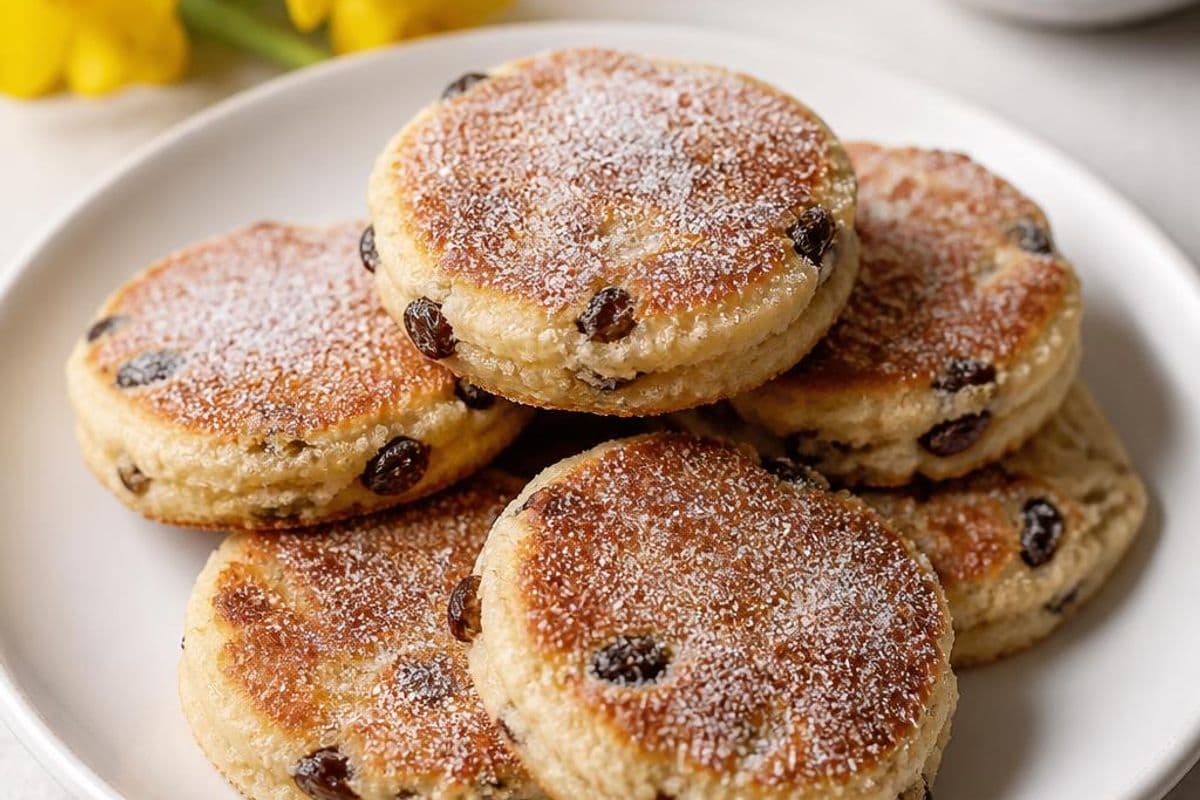
Welsh cakes for St David’s Day
Soft, lightly spiced Welsh cakes studded with currants — cooked on the hob and dusted with sugar for a proper celebratory teatime treat.
These Welsh cakes are unfussy, quick and perfect for celebrating St David’s Day — think thin, lightly spiced scones cooked on the hob until golden. They’re brilliant with a cuppa and don’t require fancy kit.
The secret is cold butter and gentle cooking: keep the heat low so the outside colours beautifully while the middle cooks through. Make them ahead and rewarm gently, or pile them high and let guests help themselves.
Ingredients
- 350 g plain flour
- 10 ml baking powder
- 75 g caster sugar — plus extra for sprinkling (about 15 g)
- 5 ml mixed spice
- salt — a pinch
- 110 g unsalted butter — cold and cubed
- 150 g currants
- 1 egg — large
- 60 ml milk — whole or semi-skimmed
Equipment
- rolling pin
- 6–7 cm round cutter
- wire rack
- heavy-based frying pan
Instructions
Put the plain flour, baking powder, caster sugar, mixed spice and salt into a large bowl and whisk together so everything is evenly distributed.
Add the cubed unsalted butter and rub it into the dry mix with your fingertips until the mixture looks like coarse breadcrumbs with some pea-sized lumps of butter remaining.
Stir the currants through the breadcrumb mix so they are evenly distributed.
Whisk the egg with the milk, then pour into the bowl and mix with a knife or spatula until the mixture comes together into a soft but not sticky dough. Add a splash more milk (no more than 1–2 tsp) only if the dough is dry.
Turn the dough onto a lightly floured surface and knead very briefly (6–8 turns) to bring it together. Press or roll the dough out to about 6 mm thick.
Cover the dough with cling film and chill in the fridge for 30 minutes to firm up — this makes cutting and cooking a lot easier.
Use a 6–7 cm round cutter to stamp out rounds. Re-roll the scraps once and repeat until all the dough is used. Keep the rounds lightly floured so they don’t stick.
Heat a large heavy-based frying pan over a medium–low hob setting. Add a small knob of unsalted butter and, as it foams, place 3–4 cakes in the pan (do not overcrowd). Cook the first side for 3 minutes until golden.
Flip the cakes and cook the second side for a further 3 minutes until both sides are golden and the cakes feel springy when pressed.
Transfer the cooked Welsh cakes to a wire rack and immediately sprinkle with a little caster sugar while still warm. Repeat with remaining dough and serve warm or at room temperature.
Tips
- Keep the butter cold and rub it in quickly — that gives the cakes a lovely crumb and stops them becoming greasy.
- If your dough softens while you work, chill it for 5–10 minutes rather than adding extra flour; over-flouring makes the cakes tough.
- Cook in small batches and adjust the hob between batches to maintain an even medium–low temperature.
- Make ahead: cool completely, store in an airtight container for up to 48 hours, then refresh on a warm frying pan for a minute each side.
- Use a 6–7 cm cutter for traditional size; larger cutters need slightly longer cooking times so check centres are cooked.
Substitutions
currants → sultanas or a 50:50 mix of sultanas and chopped dried apricots, same weight
Stays closeunsalted butter → salted butter, reduce the pinch of salt in the recipe
Stays closemilk → buttermilk or plain yoghurt thinned with a little water (approx. 60 ml total)
Noticeably differentmixed spice → ground nutmeg and a pinch of cinnamon (use 1/4 tsp nutmeg + 1/4 tsp cinnamon)
Stays close
Nutrition
Per serving · estimated
- 390
- Calories
- 6 g
- Protein
- 58 g
- Carbs
- 14 g
- Fat
- 3 g
- Fibre
- 24 g
- Sugar
- 160 mg
- Sodium
FAQ
Can I cook Welsh cakes in an oven?
You can, but they won’t get the characteristic griddle texture. Bake at 200°C fan/220°C conventional for 8–10 minutes on a baking tray and finish under a hot grill for colour if needed.
My cakes brown too quickly on the outside but are undercooked inside — what went wrong?
The pan is too hot. Reduce to medium–low and cook a little longer; also ensure the dough is not rolled too thick (6 mm is ideal).
Can I freeze Welsh cakes?
Yes — freeze in a single layer, then transfer to a bag. Freeze up to 1 month. Reheat from frozen in a warm frying pan for a couple of minutes each side.
How thick should I roll the dough?
About 6 mm. Thicker gives a doughier centre that needs longer cooking; thinner makes crisper cakes.
Community Photos
No photos yet
Be the first to share your creation!