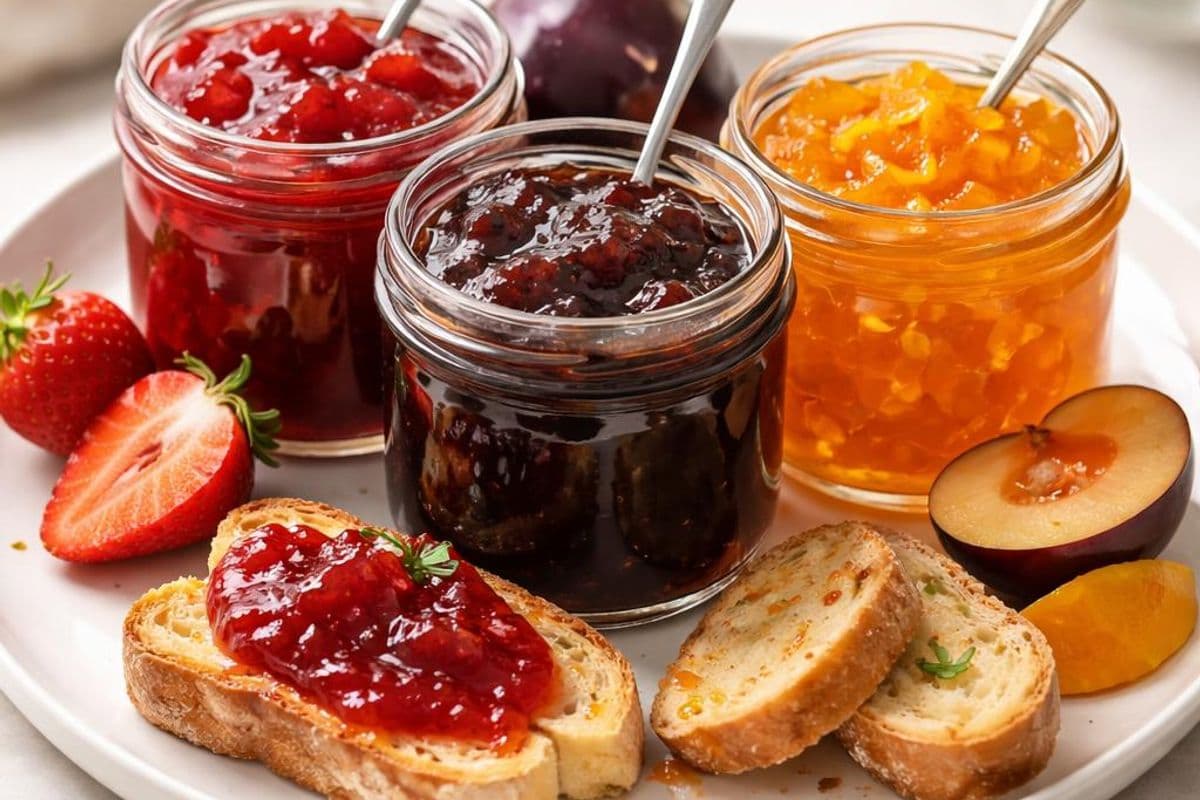
Village Fete Jam Trio: Strawberry Jam, Plum Jam & Seville Orange Marmalade
Three crowd-pleasing jams to sell at a fete: macerated strawberry, spiced plum and classic Seville orange marmalade.
A proper village fete stall needs no frills — just jam in neat jars, handwritten labels and a taste that makes people come back for more. This trio gives you a light, fruity strawberry jam, a cosy spiced plum and a classic Seville orange marmalade to tempt every palate.
They’re scaled to produce one jar of each flavour for a sale table; timing and thermometers make the difference between sellout and soggy toast. Read the critical tips — they’ll save you time and jars.
Ingredients
- 500 g strawberries — for strawberry jam
- 700 g plums — for plum jam
- 4 Seville oranges — for orange marmalade (approx. 800 g fruit)
- 1.55 kg granulated sugar
- 2 lemons — juice and a little zest for the jams
- 600 ml water — for the marmalade soak and simmer
- 10 g unsalted butter — a little to reduce foaming while boiling
- 5 ml ground cinnamon — for the plum jam
- salt — a pinch for balance
Equipment
- preserving thermometer
- jam funnel
- sterilised jam jars (approx. 3 × 340ml)
Instructions
Sterilise your jam jars and lids. Preheat the oven to 140°C fan/160°C conventional, place clean jars (no lids) on a baking tray and heat for 15 minutes. Keep lids in a pan of simmering water until needed.
Prepare the strawberries: hull and halve larger fruit so pieces are similar size.
In a large bowl, mix the strawberries with 400 g of the granulated sugar and the juice of half a lemon. Cover and leave to macerate for 1 hour so the juices develop.
Tip the macerated strawberries (and any collected juices) into a heavy-based saucepan, add the unsalted butter and bring to a vigorous rolling boil. Boil until the jam reaches setting point 104°C on a preserving thermometer or thickens when tested on a cold plate — about 20 minutes. Skim foam if necessary.
Ladle the hot strawberry jam into the hot sterilised jars, leaving 0.5 cm headspace. Wipe rims, apply lids and turn jars upside down for 5 minutes to seal, then return upright to cool.
Prepare the plums: halve and stone them. If skins are tough, score them so they break down more easily.
Place the plums in a bowl with 350 g of granulated sugar, the juice of the remaining half lemon and the ground cinnamon. Leave to sit for 30 minutes so the sugar draws out juice.
Cook the plums in a heavy-based saucepan to a rolling boil, add the unsalted butter and boil until the mixture reaches 104°C or sets on a cold-plate test — about 25 minutes. Mash a few pieces for texture if you prefer.
Jar the plum jam as you did the strawberry: hot jars, hot jam, 0.5 cm headspace, wipe rims and seal.
For the marmalade, thinly slice the Seville orange peel (pith included) and segment the fruit, discarding seeds. Put peel and segments into a large saucepan with the 600 ml water. Cover and leave to soak overnight (about 8 hours) to soften the peel and mellow bitterness.
Next day, simmer the soaked oranges and water gently until the peel is soft, about 30 minutes. Add 800 g granulated sugar, stir until dissolved, then boil rapidly until setting point 104°C or until it reaches a syrupy thickness — around 40–50 minutes. Add a knob of unsalted butter near the end to reduce foam and a pinch of salt.
Ladle the marmalade into sterilised jars as before. Leave to cool upright; lids should pop to indicate a seal.
Once all jars are cool, check seals, label with date and flavour, and store in a cool, dark place. Refrigerate any jars that did not seal.
Tips
- Use a preserving thermometer for reliable results; the jams set at about 104°C. The cold-plate test is a useful backup if you don’t have one.
- Sterilise jars in a hot oven and keep lids hot in simmering water — this reduces the risk of spoilage and helps jars seal.
- Avoid overcooking: jams continue to thicken as they cool. If you overset slightly, stir in a tablespoon or two of hot water and reheat briefly.
- Prepare the marmalade a day ahead (soak overnight) — the extra waiting makes the peel tender and the flavour better.
- If selling at a fete, include simple labels with ingredients and a sell-by date (use within 12 months unopened).
Substitutions
granulated sugar → jam sugar (1:1 by weight) — speeds setting and gives a clearer jelly
Stays closeSeville oranges → ordinary cooking oranges or a mix of sweet orange and a lemon for acidity (use more lemon juice)
Noticeably differentunsalted butter → a teaspoon of vegetable oil to reduce foaming
Stays close
Nutrition
Per serving · estimated
- 55
- Calories
- 0 g
- Protein
- 14 g
- Carbs
- 0 g
- Fat
- 1 g
- Fibre
- 13 g
- Sugar
- 5 mg
- Sodium
FAQ
How do I know when jam has set?
The reliable way is a preserving thermometer reading 104°C. Alternatively, chill a small plate, put a teaspoon of jam on it and push with your finger — if the surface wrinkles, it’s set.
Can I use jam sugar instead of granulated sugar?
Yes — jam sugar contains added pectin or sugar crystals that help setting and usually gives a clearer set; use equal weights.
How long will unopened jam keep?
Properly sterilised jars stored in a cool, dark place will keep for up to 12 months. Refrigerate any jar that fails to seal and use within a few weeks.
My marmalade is too bitter — what went wrong?
Seville marmalade has a characteristic bitterness. If excessive, try blanching the peel in three changes of boiling water before soaking next time, or reduce the amount of pith you include.
Community Photos
No photos yet
Be the first to share your creation!