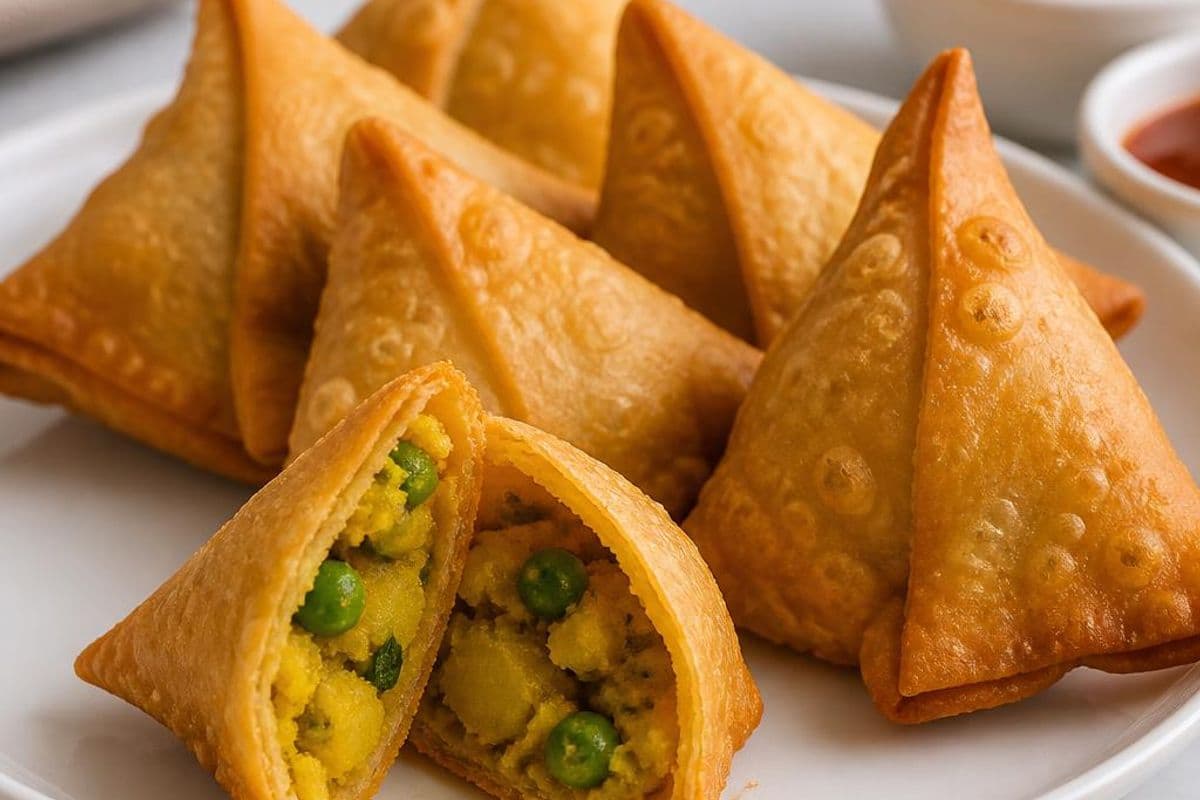
Vegetable Samosas (Potato & Pea)
Crisp golden pastry filled with spiced mashed potato and peas — classic Indian tea-time samosas, made at home and fried until perfectly flaky.
Samosas are the cheeky, triangular heroes of Indian teatime — deep‑fried parcels of spicy comfort that disappear in seconds. This version keeps things classic: a lemony, spiced potato-and-pea filling tucked inside a firm, flaky pastry that crisps up nicely when fried.
Make them for guests, a picnic (they travel well), or whenever you need handheld joy. The recipe is written vegan-friendly from the start; swap ghee in the dough if you want the indulgent, traditional aroma.
Ingredients
- 300 g plain (all‑purpose) flour
- 50 g fine semolina (rava) — optional — adds extra crispness
- 5 ml salt
- 30 ml vegetable oil (for dough)
- 120 ml cold water (for dough) — add a little more if needed to form a firm dough
- 500 g potatoes (waxier variety like Maris Piper or Yukon), peeled — about 3 medium
- 150 g frozen peas
- 15 ml vegetable oil (for filling)
- 5 ml cumin seeds
- asafoetida (hing) — a pinch (optional)
- 2 pcs green chillies — finely chopped; reduce for less heat
- 15 ml fresh ginger — grated
- 5 ml turmeric powder
- 5 ml ground coriander
- 5 ml garam masala
- 15 ml lemon juice or amchur (dried mango powder) — or 1 tsp amchur
- 30 ml fresh coriander (cilantro) — chopped
- 5 ml sugar — balances the acidity; optional
- 0 ml black pepper — optional
- 15 ml plain flour (for sealing paste)
- 30 ml water (for sealing paste)
- oil for deep‑frying — about 1–1.2 litres (or enough for deep frying in your pan)
Equipment
- deep heavy‑based frying pan or wok
- candy or frying thermometer (helpful)
- slotted spoon or skimmer
- rolling pin
- wire rack for draining
Instructions
Make the pastry dough: In a large bowl combine the plain flour, semolina and 1 tsp salt. Add 2 tbsp vegetable oil and rub with your fingertips until mixture resembles coarse breadcrumbs.
Add cold water little by little and bring the mixture together into a firm but pliable dough. Knead on a lightly floured surface for 5 minutes until smooth. Cover with clingfilm or a damp tea towel and rest for 30 minutes.
Boil the potatoes whole in salted water until just tender (about 15–18 minutes). Drain, cool for 10 minutes, then peel and roughly mash — leave some texture rather than a puree.
Cook the filling: Heat 1 tbsp oil in a frying pan over medium heat. Add cumin seeds and a pinch of asafoetida; when they sizzle (about 10–15 seconds) add the chopped green chillies and grated ginger and fry for 30 seconds.
Add turmeric, ground coriander and garam masala; stir for 15–20 seconds to bloom the spices. Toss in frozen peas and cook 3–4 minutes until heated through and tender.
Add the mashed potatoes to the spice/pea mix. Add lemon juice (or amchur), sugar, black pepper and salt to taste. Mix gently until combined, then fold through chopped coriander. Taste and adjust seasoning. Allow the filling to cool completely (at least 10 minutes).
Divide rested dough into 12 equal pieces (about 40–45g each). Roll each piece into a smooth ball, then flatten to a 10cm (4 inch) disc.
Make cones: Roll each disc into an oval, cut in half lengthways to make two semi‑circles. Take one semi‑circle, form into a cone by bringing straight edge corners together and overlapping by about 1cm, then press and seal the overlap using a little of the flour‑water paste (mix 1 tbsp plain flour + 2 tbsp water).
Fill each cone with about 2 heaped tablespoons of the cooled filling, leaving room at the top to seal. Dab the open edges with sealing paste and press firmly to close. Tuck and pinch to form the classic triangular samosa shape.
Heat oil for deep‑frying to 170–180°C (340–355°F). If you don't have a thermometer, test with a small cube of dough: it should rise slowly and steadily with gentle bubbling. Fry samosas in small batches, turning occasionally, until evenly golden — about 6–8 minutes per batch.
Remove samosas with a slotted spoon onto a wire rack or tray lined with kitchen paper to drain for 2–3 minutes, then transfer to a warm plate. Serve hot with tamarind chutney, mint chutney or ketchup.
Baking alternative (optional): For a lighter version, brush samosas lightly with oil and bake at 200°C (fan 180°C / 400°F) for 25–30 minutes, turning halfway, until golden and crisp. Texture will be slightly different (less deep‑fried flakiness).
Tips
- Use a firm, slightly waxy potato (Maris Piper/Yukon Gold) — they hold texture and don’t turn gluey.
- Add the peas after the spices bloom so they don’t become pasty; briefly mash the potatoes so the filling still has some bite.
- Rest the dough for 30 minutes — this prevents the pastry shrinking back when you try to roll, and reduces tearing when shaping cones.
- If making ahead: shape raw, unfried samosas and freeze them on a tray. Once frozen, store in a bag and fry straight from frozen (add a minute or two to frying time).
- Control oil temperature: use a thermometer or test piece of dough. Keep it around 170–180°C for even cooking and minimal oil absorption.
Substitutions
potatoes → sweet potato (use same weight, may need 1–2 tbsp lemon juice to balance sweetness)
Noticeably differentpeas → finely diced carrot or cauliflower florets (par‑boil first)
Stays closevegetable oil (for frying) → sunflower or peanut oil (good high‑smoke alternatives)
Stays closesemolina (rava) → omit (dough will still work but be slightly less crisp)
Stays close
Nutrition
Per serving · estimated
- 420
- Calories
- 8 g
- Protein
- 58 g
- Carbs
- 16 g
- Fat
- 6 g
- Fibre
- 5 g
- Sugar
- 430 mg
- Sodium
FAQ
Can I make samosas ahead and reheat?
Yes — fry and cool completely, then store in the fridge for 2 days. Reheat in a 180°C oven for 8–10 minutes to crispen. For longer storage, freeze uncooked (on a tray) and then bag — fry from frozen.
How do I stop samosas from bursting while frying?
Ensure the filling is cool and not overfilled, seal edges with a good flour paste, and keep oil at a steady 170–180°C. Don’t overcrowd the pan which drops the oil temperature.
Can I shallow‑fry or bake instead of deep‑frying?
Yes. Shallow‑frying works but you’ll need to turn more frequently and use slightly more oil on each side. Baking gives a lighter result—brush with oil and bake at 200°C for 25–30 minutes, turning once.
Why add semolina to the dough?
A small amount of fine semolina gives extra crunch in the fried pastry. It’s optional — omit if you prefer purely flour pastry.
Community Photos
No photos yet
Be the first to share your creation!