Osso Buco alla Milanese (Braised Veal Shanks)
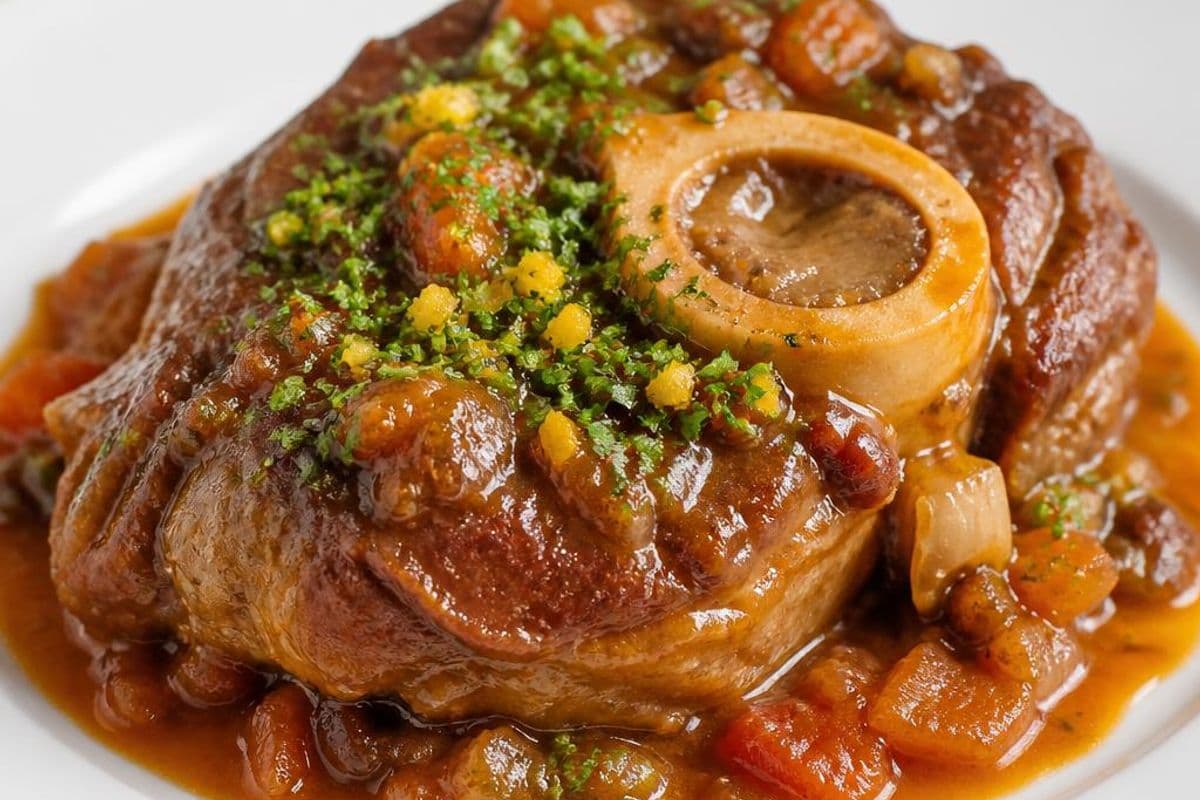
Slow‑braised veal shanks in a rich wine‑tomato jus, finished with bright gremolata. Silky sauce, soft meat that falls off the bone and that glorious marrow centre — classic northern‑Italian comfort.
Osso buco is the kind of dish that makes friends jealous and in‑laws impressed — without much heroic effort. Threaded through Italian kitchens, it’s a simple idea: brown the marrow‑rich veal, braise it slowly with wine, tomatoes and aromatics, and finish with a punchy gremolata to cut through the richness.
Make this when you’ve got time and want maximum return for minimal hands‑on fuss — perfect for a slow Sunday supper or an impressive midweek treat. Serve it with saffron risotto alla Milanese or creamy polenta to mop up that gorgeous sauce.
Ingredients
- 4 shanks Veal shanks (ossobuco), bone‑in — about 300–350 g each
- Sea salt — to taste (see step notes)
- Freshly ground black pepper — to taste
- 60 g Plain flour (for dredging) — about 1/2 cup
- 45 ml Olive oil
- 15 g Unsalted butter — optional, for finishing
- 1 medium Yellow onion — about 150 g, finely diced
- 1 large Carrot — finely diced
- 2 stalks Celery — finely diced
- 3 cloves Garlic — 2 in the sauce (crushed), 1 in the gremolata (minced)
- 30 ml Tomato paste — concentrated
- 400 g Canned plum tomatoes — roughly chopped
- 200 ml Dry white wine — or dry vermouth
- 600 ml Beef or veal stock — low‑salt recommended
- 2 leaves Bay leaves
- 3 sprigs Fresh thyme
- 20 g Flat‑leaf parsley — for gremolata, finely chopped
- 1 zest Lemon zest — zest of 1 lemon (use microplane)
- 5 ml Extra virgin olive oil (for gremolata)
- Cracked black pepper (gremolata) — a pinch
Equipment
- Large heavy casserole or Dutch oven
- Tongs
- Slotted spoon
- Microplane or fine zester
Instructions
Pat the veal shanks dry with kitchen paper. Season both sides and the exposed marrow with a generous pinch of sea salt and a good grind of black pepper.
Lightly dredge each shank in the flour, shaking off excess so there's a thin, even coating.
Heat a large heavy casserole or Dutch oven over medium‑high. Add the olive oil. When shimmering, brown the shanks in batches—about 3–4 minutes per side—so they get a deep golden crust. Transfer browned shanks to a plate.
Turn the heat down to medium. If there's more than about 2 tbsp of fat in the pan, carefully pour off most of it, leaving the fond (brown bits). Add the diced onion, carrot and celery (soffritto) and a pinch of salt. Sweat gently, stirring, until softened and starting to colour, about 8–10 minutes.
Add the crushed garlic and tomato paste, stir and cook 1–2 minutes until the paste darkens slightly (this deepens flavour).
Pour in the white wine to deglaze the pan, scraping up any browned bits. Let it bubble briskly and reduce by about half (about 2–3 minutes).
Add the chopped canned tomatoes, stock, bay leaves and thyme. Bring to a gentle simmer. Return the shanks to the pot, nestling them into the sauce; the liquid should come about two‑thirds up the sides of the shanks (not completely cover them).
Cover the pot with a lid (or foil plus lid) and transfer to an oven preheated to 160°C (320°F). Braise until the meat is tender and pulls away from the bone, 2 to 2½ hours. Check at 90 minutes: if the liquid is reducing too fast, add a splash more stock.
Carefully remove the shanks to a warm plate. Skim any excess fat from the surface of the sauce. Bring the sauce to a gentle simmer on the hob and reduce for 6–10 minutes until slightly thickened and glossy. Taste and season with salt and pepper.
If you like a silkier finish, whisk in the optional butter (15 g) off the heat. Return the shanks to the sauce to warm for 1–2 minutes.
Make the gremolata: combine the chopped parsley, lemon zest and the minced garlic with 1 tsp extra virgin olive oil and a pinch of cracked black pepper. Mix just before serving.
To serve: place each shank on a bed of saffron risotto or creamy polenta. Spoon generous sauce around, finish with a mound of gremolata over the exposed marrow and a final drizzle of olive oil.
Tips
- Brown the shanks properly — pat dry and don’t crowd the pan. Colour = flavour.
- If the sauce is too acidic from the tomatoes, a teaspoon of sugar or a knob of butter (optional) calms it without making the dish sweet.
- Make the gremolata last minute so the lemon zest and garlic stay bright; you can make the sauce a day ahead and gently reheat.
- Check liquid at around 90 minutes; add small splashes of stock if reduced too fast to prevent drying.
- Leftovers taste even better the next day — cool, refrigerate, then gently reheat on low.
Substitutions
Veal shanks → Beef short ribs or beef shanks (same technique, may need slightly longer braise)
Stays closeWhite wine → Dry vermouth or extra stock with 1 tbsp vinegar (red or white)
Stays closePlain flour (dredge) → No dredge (skip flour) or use 40 g cornflour for gluten‑free
Noticeably differentBeef or veal stock → Good‑quality chicken stock
Stays close
Nutrition
Per serving · estimated
- 700
- Calories
- 50 g
- Protein
- 20 g
- Carbs
- 38 g
- Fat
- 4 g
- Fibre
- 6 g
- Sugar
- 700 mg
- Sodium
FAQ
Can I make osso buco the day before?
Yes — flavours deepen overnight. Cool completely, refrigerate and gently reheat on the hob; add a splash of stock if the sauce tightens.
How do I tell when the meat is done?
Done when a fork slides through the meat easily and it pulls away from the bone; the meat should feel pull‑apart tender, not chewy.
Do I have to dredge the shanks in flour?
No — dredging helps with browning and gives a slightly thicker sauce, but you can skip it (or use cornflour for gluten‑free).
What's the point of the marrow?
The marrow in the bone adds unctuous richness. Scoop and spread it on risotto or bread, or mix a little into the sauce for extra silkiness.
Community Photos
No photos yet
Be the first to share your creation!