Classic British Pork Pie (Hot-Water Crust)
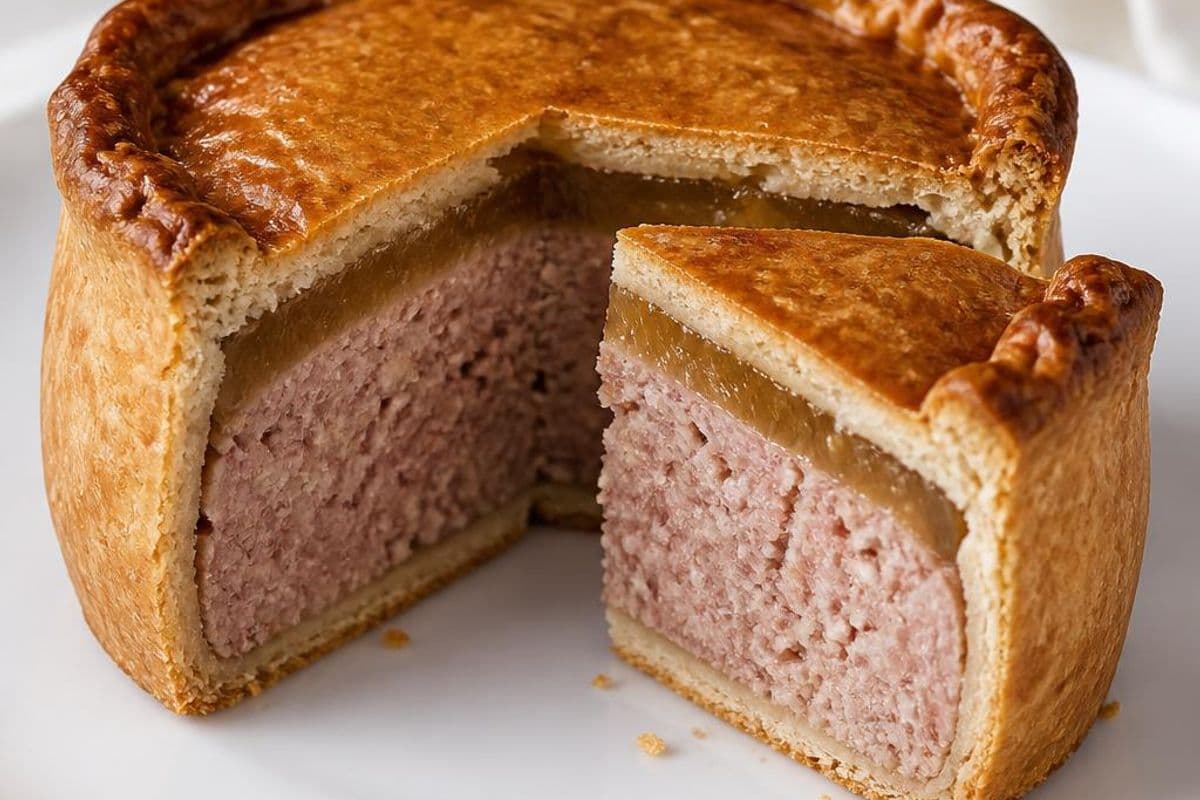
A proper, make-ahead British pork pie with sturdy hot-water crust, seasoned pork filling and a clear aspic. Cuts neat, keeps well and tastes even better the next day — jackpot for picnics, ploughman’s lunches or a smug display in the fridge.
This is proper British comfort: a hot‑water crust pork pie — sturdy, selfishly meaty and gloriously portable. The crust is made with melted fat and hot water so it sets firm enough to hold a pocket of clear aspic (that’s the lovely jelly you pour in after baking).
Make it for picnics, ploughman’s lunches or when you want something you can make ahead and show off. It takes a bit of time (mostly waiting), but none of the steps are tricky — just keep things cold and be confident with your sealing.
Ingredients
- 450 g Plain (all-purpose) flour
- 200 g Lard (solid) — can use 150g lard + 50g unsalted butter for a bit of flavour
- 5 ml Sea salt (for pastry) — about 6 g
- 1 Large egg (for pastry)
- 200 ml Boiling water (for pastry) — add hot to melted fat
- 600 g Pork shoulder, trimmed — cut into chunks for mincing or ask butcher to mince
- 400 g Pork belly, skin removed, finely diced — gives rich pockets of flavour/fat within the filling
- 10 ml Sea salt (for filling) — about 10 g, adjust to taste
- 5 ml Freshly ground black pepper
- 5 ml Ground nutmeg (or mace)
- 5 ml English mustard powder — optional, for a subtle tang
- 15 ml Fresh thyme leaves, chopped — optional
- 1 Large egg (for filling) — binds the filling
- 15 ml Cold water (for filling)
- 500 ml Pork or good chicken stock — for aspic; strong stock works best
- 10 g Powdered gelatine — ≈ 3 tsp (or use 4 gelatine sheets, bloom as per pack)
- 1 Large egg (for egg wash)
- 15 ml Milk (for egg wash) — or water if you want dairy-free
- 5 ml Neutral oil or butter (for greasing tin)
Equipment
- 20 cm (8 in) deep loose-bottom pie tin or deep round tin
- Rolling pin
- Meat grinder or food processor (or buy minced pork from butcher)
- Small saucepan (for hot fat and stock)
- Funnel or small ladle (to pour aspic)
- Probe thermometer
Instructions
Prep the meat: keep everything cold. Cube the pork shoulder and pork belly so they’ll pass through a grinder easily. Grind/coarsely mince the pork shoulder and pork belly together (or use pre-minced pork but keep it chilled).
Season the mince: put the minced pork in a bowl and mix in the 2 tsp sea salt, black pepper, nutmeg, mustard powder (if using) and chopped thyme. Add 1 large egg and 1 tbsp cold water and mix to combine. Taste a tiny pinch fried in a pan (optional) and adjust seasoning. Cover and chill for 30 minutes to let flavours settle.
Make the hot-water crust pastry: put the lard and 200 ml boiling water in a small saucepan and heat gently until the lard has fully melted and the mixture is just simmering. Remove from the heat and let the fat-water cool for about 1–2 minutes — it should still be hot but not scalding. Beat 1 large egg in a small bowl and whisk a spoonful of the hot fat-water into it to temper, then whisk the egg mixture back into the saucepan. Sift the 450 g flour and 1 tsp salt into a bowl, make a well and pour in the hot fat-egg mixture. Stir with a wooden spoon until it comes together, then turn out and knead briefly until smooth. Wrap in clingfilm and chill for 30 minutes.
Preheat the oven to 200°C (fan 180°C). Grease a 20 cm (8 in) deep loose-bottom pie tin or similar and dust your work surface with a little flour. Remove pastry from the fridge and divide: about two-thirds for the case, one-third for the lid. Roll the larger piece to a circle big enough to line the tin and up the sides. Press the pastry into the tin, making sure the base and sides are even and there are no large air gaps. Trim the edges so there’s a good overhang for sealing later.
Fill the pie: pack the seasoned pork filling into the pastry case, pressing down gently as you go to remove big air pockets but don’t compact it like a meatloaf — a little room for juices improves texture. Leave about 1.5 cm (1⁄2 in) gap beneath the rim for the lid to sit into. Score or mark the top of the filling so it settles evenly. Trim the lid to size, dampen the rim with a little water and seal the lid snugly. Make one small central vent hole (or leave a small pastry plug you can remove after baking to pour in the aspic). Brush all over with the egg + milk wash.
Bake in two stages for a deep golden crust: put the pie in the oven at 200°C for 25 minutes, then reduce the oven to 170°C and bake for a further 35 minutes (total about 60 minutes) until the pastry is deeply golden.
Check the filling temperature: the centre should reach at least 71°C (160°F). If it hasn’t, return to the oven for another 10–15 minutes and re-check.
Make the aspic: while the pie bakes (or immediately after), bloom 9 g powdered gelatine in 2 tbsp cold water for 5 minutes. Heat 500 ml strong stock until just under a simmer, remove from the heat and stir in the bloomed gelatine until fully dissolved. Allow the stock to cool to warm (about 10 minutes) — warm enough to flow but not hot enough to melt the inside of the baked pie.
Cool the pie until it is warm, not hot — about 30–45 minutes at room temperature. If you baked with a removable plug, remove it now (or pierce the vent hole) and carefully pour the warm aspic into the cavity using a funnel or small ladle until the pie is nearly full. Replace the pastry plug or seal the hole with a small disc of pastry. Brush the top with a final egg wash if you like, then leave the pie to cool a little more before chilling.
Chill the pie, uncovered in the fridge, for at least 6 hours or overnight so the aspic sets firm. Before serving, remove from the tin and slice with a sharp knife. Keep refrigerated and eat within 4–5 days.
Tips
- Keep everything cold when handling the meat — chill bowls, mince in short bursts and return to the fridge between steps if the pork feels warm.
- If you don’t have a meat grinder, buy good coarse minced pork and fold in small-diced pork belly for texture and fat pockets.
- Use a probe thermometer to check the filling reaches 71°C (160°F) — visual cues alone can be misleading.
- Make the pie a day ahead — flavours settle and the aspic sets firmer, making cleaner slices.
- If your pastry cracks when placing the lid, patch with a little pastry paste (flour + water) and press to seal; small hairline cracks will seal with the egg wash.
Substitutions
Lard → 150 g lard + 50 g unsalted butter
Stays closePowdered gelatine → 4 gelatine sheets (bloomed as per pack instructions)
Stays closePlain white flour (pastry) → gluten-free plain flour mix (check for xanthan gum)
Noticeably differentPork belly → streaky bacon (fatty), finely chopped
Stays close
Nutrition
Per serving · estimated
- 820
- Calories
- 25 g
- Protein
- 43 g
- Carbs
- 59 g
- Fat
- 2 g
- Fibre
- 2 g
- Sugar
- 900 mg
- Sodium
FAQ
Can I make the filling a day ahead?
Yes — mix the filling, cover and refrigerate overnight. Cold filling makes assembly easier and the flavours develop nicely.
My pastry cracks while covering the pie — what now?
Patch small cracks with a little paste made from flour + water or a dab of beaten egg, press to seal and continue. Major cracks are usually from dry dough — next time add a touch more warm liquid.
Do I need to use pork stock for the aspic?
No — good, strong chicken stock will set fine and tastes clean. Pork stock gives a more traditional porky flavour.
Can I freeze the pie?
Yes: freeze before pouring in the aspic (wrap well) for up to 3 months. Defrost, bake and then add aspic, or fully bake and freeze, then thaw and serve (aspic won’t always reset perfectly after freezing).
Community Photos
No photos yet
Be the first to share your creation!