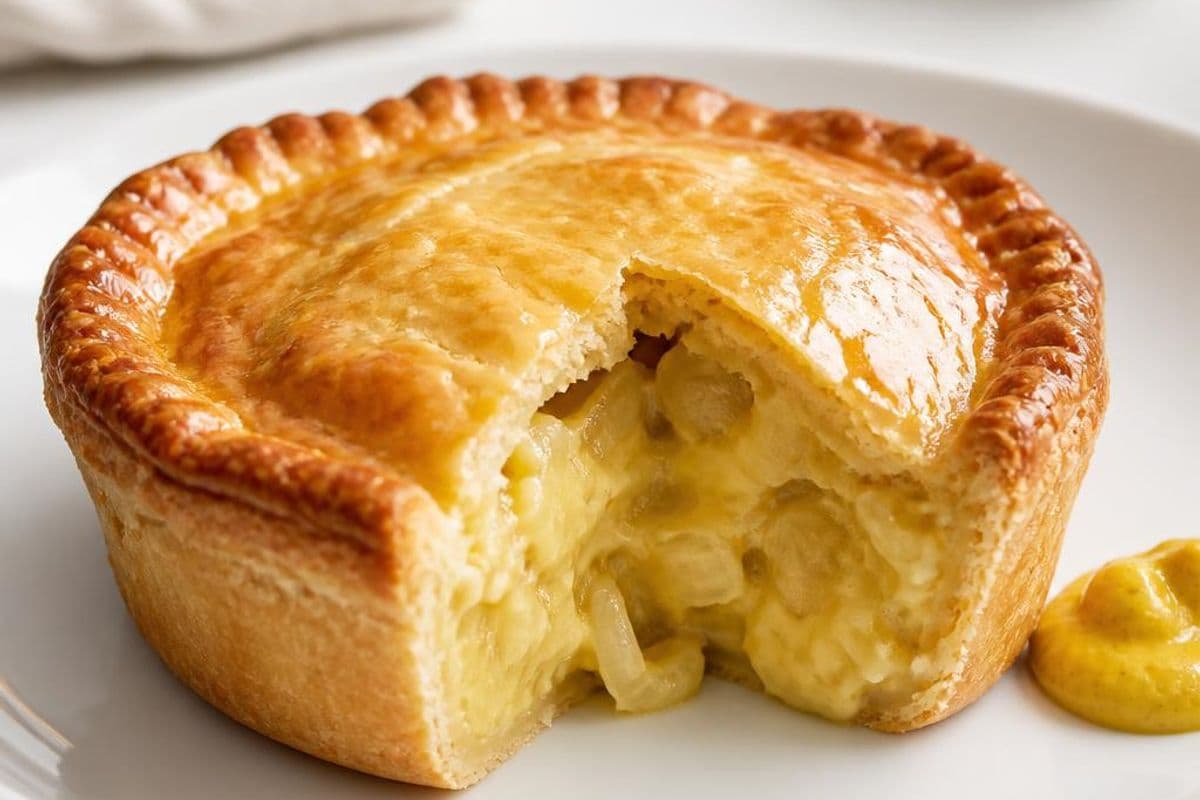
Cheese and Onion Pie
A comforting British pie of slow‑caramelised onions folded into a tangy cheddar custard and encased in crisp shortcrust pastry — proper homely food that sings with mustard and a glossy golden top.
Cheese and onion pie is Britain in a dish: comforting, a bit cheeky and immensely satisfying. Slow‑caramelised onions give deep sweetness that plays perfectly against a sharp, mature cheddar and a mustardy custard — all wrapped in crisp shortcrust pastry.
Make it for a weekend lunch with a sharp pickle and a cold pint, or for supper when you want something that feels like a proper hug. The long onion‑cooking time repays you with flavour, but most of the work is hands‑off, so you can get on with the rest of Sunday.
Ingredients
- 300 g plain flour
- 175 g unsalted butter (for pastry) — very cold, diced
- 5 ml salt (for pastry)
- 60 ml ice water — plus extra 1–2 tbsp if needed
- 3 large eggs — 2 for the filling, 1 for egg wash
- 800 g onions — about 4–5 medium, thinly sliced
- 30 g unsalted butter (for onions)
- 15 ml olive oil
- 15 ml caster sugar — optional — helps caramelisation
- 2 cloves garlic — minced, optional
- 300 g mature cheddar — coarsely grated
- 150 ml double cream
- 30 ml Dijon mustard
- 5 ml Worcestershire sauce
- 30 ml plain flour (for filling) — helps bind filling
- black pepper — to taste
- salt — to taste (be cautious — cheddar is salty)
- 15 ml fresh thyme leaves — optional; plus extra sprigs to garnish
- ready‑made shortcrust pastry — If using shop pastry, buy a 375–400g pack and skip pastry steps
Equipment
- 23cm loose‑bottom tart tin or 9‑inch pie dish
- rolling pin
- pastry brush
- food processor (optional for pastry)
- wide frying pan (for onions)
Instructions
Make the shortcrust pastry: Put the 300g plain flour and 1 tsp salt in a large bowl. Rub in the 175g cold diced butter with your fingertips until the mix resembles coarse breadcrumbs (or pulse briefly in a food processor). Sprinkle with 60ml ice water a tablespoon at a time and bring the dough together — it should hold when pressed but not be sticky. Form into a disk, wrap and chill in the fridge for at least 30 minutes.
Caramelise the onions: Heat a large frying pan over medium, add 30g butter and 1 tbsp olive oil. Add the sliced onions and a pinch of salt. Cook gently on medium‑low for 30–40 minutes, stirring every 3–5 minutes so they brown evenly (reduce heat if they catch). After 25–30 minutes add 1 tbsp caster sugar and the minced garlic, and continue to cook until deep golden and sweet. If the pan dries out, splash in a tablespoon or two of water to deglaze.
Preheat the oven to 200°C (180°C fan) / 400°F / Gas 6.
Make the filling mixture: In a bowl whisk together 2 large eggs, 150ml double cream, 2 tbsp Dijon mustard, 1 tsp Worcestershire sauce and 2 tbsp plain flour until smooth. Season with black pepper; hold back on extra salt until after you add the cheese — cheddar can be quite salty.
Fold the cooled (or just warm) caramelised onions and about two‑thirds of the grated 300g cheddar into the custard mix. Taste and add salt only if needed. Stir in a tablespoon of chopped thyme (if using).
Roll and line the tin: On a lightly floured surface roll two‑thirds of the chilled pastry to a circle about 3cm larger than a 23cm loose‑bottom tart tin (or 9‑inch pie dish). Gently lift and press into the tin, trimming the overhang to roughly 2cm. Chill for 10 minutes while you roll the lid.
Fill the pie: Spoon the cheese and onion filling into the pastry case and level with a spatula. Grate the remaining cheddar over the top.
Top the pie: Roll the remaining pastry to form a lid. Brush the pastry rim with a little beaten egg (from the reserved egg) and lay the lid over the filling; press and crimp the edges to seal. Trim any excess. Make 3 small slits in the top to vent steam and brush the top with the beaten egg (add 1 tbsp milk if you want a deeper glaze). Garnish with a few thyme sprigs if desired.
Bake the pie on the middle shelf for 40 minutes. After 40 minutes check the crust: it should be deep golden. If the top is browning too quickly, loosely tent with foil and continue baking a further 10–15 minutes until the centre of the filling is just set (it will still jiggle slightly).
Rest the pie for 10–15 minutes before slicing. This helps the filling finish setting and makes cleaner slices.
Serve warm or at room temperature with a crisp green salad or chutney on the side.
Tips
- Caramelise the onions patiently — 30–40 minutes at medium‑low gives that nutty, sweet depth you can't fake. Use a wide pan so they brown rather than steam.
- If you’re short on time, use shop pastry but still caramelise the onions — that’s where the flavour lives.
- For a crisper base, blind‑bake the lined pastry shell for 12 minutes, then cool slightly before adding the filling (not essential but helps against soggy bottoms).
- Cool the onions a little before adding to the egg mixture — hot onions can cook the egg and give a grainy texture.
- Leftovers reheat well: warm slices in a 160°C oven for 15–20 minutes to revive the pastry. Freeze whole or in slices for up to 2 months.
Substitutions
double cream → 150ml whole milk + 50g full‑fat Greek yoghurt
Noticeably differentmature cheddar → 260g Lancashire or 300g strong Red Leicester
Stays closeshortcrust pastry (homemade) → 1x 375–400g block ready‑rolled shortcrust pastry
Stays closeDijon mustard → 1½ tbsp English mustard (hotter, a bit sharper)
Noticeably different
Nutrition
Per serving · estimated
- 760
- Calories
- 20 g
- Protein
- 50 g
- Carbs
- 54 g
- Fat
- 3 g
- Fibre
- 7 g
- Sugar
- 800 mg
- Sodium
FAQ
Can I make the pie ahead?
Yes — you can assemble and keep it covered in the fridge up to 24 hours before baking. Alternatively, bake fully, cool and refrigerate; reheat in a 160°C oven until warm.
My bottom pastry went soggy. How do I avoid that?
Blind‑bake the base for about 12 minutes, or ensure your pastry is well chilled before baking. Also make sure your filling isn’t too hot when you put it into the case.
Can I use a different cheese?
Yes — choose a full‑flavoured cheese. Lancashire or Red Leicester keep a strong cheesy character; softer cheeses will make the filling looser.
How do I know the filling is cooked?
The centre should be mostly set with a slight wobble. If completely liquid it needs more time; if very firm it’s probably overcooked and a bit dry.
Community Photos
No photos yet
Be the first to share your creation!